
Lancaster County Prothonotary Office
The Lancaster County Prothonotary records and files legal papers on the civil side of the Court of Common Pleas. Pennsylvania court listings identify Andrew E. Spade as Lancaster County Prothonotary. The office is not the criminal filing office, and it is not the Register of Wills. Its work centers on civil complaints, later pleadings, judgments, liens, family filings, divorce, custody, PFA documents, name changes, civil public records requests, and other civil court papers.
The Prothonotary page is the local source for Lancaster County civil and family filing categories.
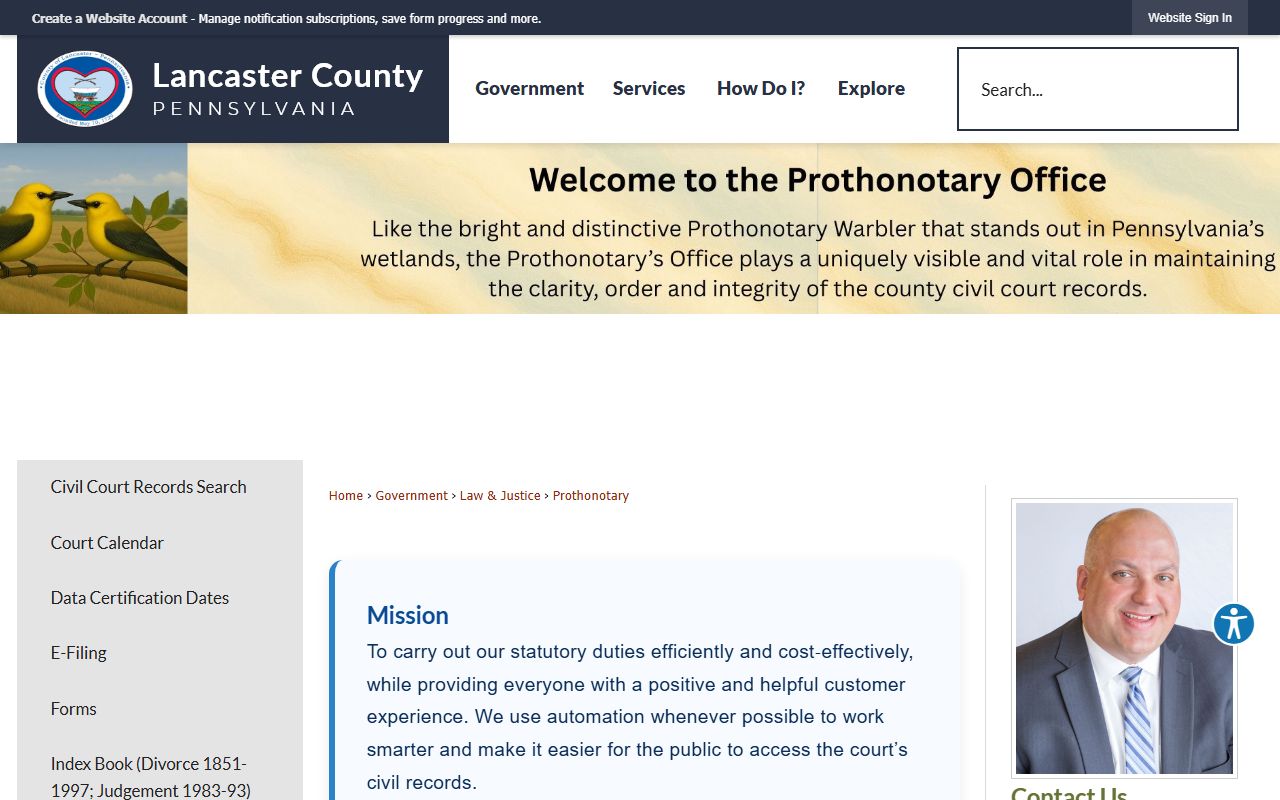
That source separates Prothonotary civil duties from criminal Clerk of Courts duties, which is important in Lancaster County's split-clerk system.
Lancaster County Prothonotary
Prothonotary: Andrew E. Spade
50 North Duke Street, P.O. Box 83480
Lancaster, PA 17608
717-299-8282
Fax: 717-293-7210
Monday-Friday, 8:30 a.m.-5 p.m.
Lancaster County Clerk Split
Lancaster County uses Pennsylvania's split clerk structure. The Prothonotary is the civil-side filing and records office for the Court of Common Pleas. The Lancaster County Clerk of Courts is the separate criminal and juvenile filing office. The Register of Wills and Clerk of Orphans' Court handles probate, estates, adoptions, guardianships, and marriage licenses. A search can fail if it starts in the wrong office.
The county's Clerk of Courts page documents the criminal and juvenile office that is separate from the Prothonotary.
That distinction keeps civil record requests with the Prothonotary and criminal filing questions with the Clerk of Courts.
| Office | Main Lancaster County Records | Use It For |
|---|---|---|
| Prothonotary | Civil, family, divorce, custody, PFA, judgments, liens | Civil filings and civil certified copies |
| Clerk of Courts | Criminal and juvenile Court of Common Pleas filings | Criminal motions, pleas, bail, commitments, appeals |
| Register of Wills / Clerk of Orphans' Court | Estates, wills, guardianships, adoptions, marriage licenses | Probate and Orphans' Court files |
Lancaster County Civil Records
The Prothonotary accepts civil complaints and later pleadings, service filings and affidavits, judgments and liens, license suspension appeals, appeals from Magisterial District Judges and higher courts, name change petitions, divorce filings, custody petitions, guardianship filings listed by the Prothonotary, Protection From Abuse documentation, notices, certifications, administrative orders, miscellaneous petitions and motions, civil public-records requests, and naturalization records.
All filings must include an affidavit regarding generative artificial intelligence under a local court administrative order. That requirement is a current Lancaster County procedure detail. It applies to filings made with the office, so filers should not rely on old forms or prior filing habits without checking current Prothonotary instructions.
Several Prothonotary record groups are easy to confuse with records held elsewhere. Divorce, custody, and PFA filings are civil-side family records, so they belong with the Prothonotary even when the dispute feels personal or urgent. Criminal commitments, guilty pleas, and adult criminal expungement petitions belong with the Clerk of Courts. Estate files, marriage licenses, adoptions, and many guardianship matters are tied to the Register of Wills and Clerk of Orphans' Court. Starting with the right office helps avoid a rejected request or an unnecessary courthouse trip.
- Civil complaints and later pleadings begin and develop civil case files.
- Judgments and liens can affect property, credit, and enforcement steps.
- Divorce, custody, and PFA documents are family-side Prothonotary filings.
- MDJ appeals and license suspension appeals move lower-level matters into Common Pleas review.
- Naturalization and older civil indexes may require office or archive-style searching.
Lancaster County Prothonotary Search
Lancaster County's public records hub links civil and criminal court records, and the Prothonotary civil search routes to CountySuite. The portal is official but JavaScript and vendor gated in plain research. The captured search language showed name and case-number routes, including search by case number, participant name, participant address, and advanced options. UJS may show many civil dockets, but CountySuite is the county route for Prothonotary civil records.
The official CountySuite civil court records portal is the online path linked for Lancaster County Prothonotary civil records.

CountySuite is useful when the searcher has a civil case number, party name, or participant address tied to a Lancaster County civil filing.
| Search Option | Use | Notes |
|---|---|---|
| Name or Case Number | Broad civil lookup | Good first route when exact case data is uncertain. |
| Case Number | Known docket lookup | Best when a complaint, decree, or order lists the number. |
| Participant Name | Party search | Use full names and alternate spellings where possible. |
| Participant Address | Address-based search | Helpful for liens, judgments, or property-related civil matters. |
Request Lancaster County Certified Copies
Certified Prothonotary copies are often needed when a court order, decree, judgment, or civil filing must be used outside the online docket. Divorce decrees are a common example. Lancaster County's divorce decree request form requires case details and party names, and certified decree requests must be mailed with a self-addressed stamped envelope. Non-certified divorce decree requests may be emailed when certification is not needed.
Older or partly indexed civil records may need more than a name search. The research notes older divorce index coverage from 1851 through 1997 and judgment index coverage from 1983 through 1993 on the Prothonotary page. Current records usually start with modern civil search tools, but an older decree, judgment, lien, or naturalization record may require office help, an approximate year, alternate names, or a manual search. For certified copies, the office needs enough detail to identify the correct paper, not just the type of case.
- Find the civil case number through CountySuite, UJS, older index coverage, or the records already in hand.
- Identify the exact document, such as divorce decree, judgment, order, complaint, or certification.
- Prepare the request with party names, docket number if known, approximate year if needed, contact details, and mailing address.
- Include the required fee payable to Lancaster County Prothonotary and add a self-addressed stamped envelope for certified mailed copies.
- Send or present the request to the Prothonotary, then wait for office processing or pickup instructions.
Lancaster County Request Fields
The divorce decree request form gives the clearest researched field inventory for a Prothonotary certified copy request. Even when a different civil document is needed, the same logic applies: identify the case, identify the parties, identify the document, give the office a way to reach the requester, and include payment when required.
| Field | Required Use | Notes |
|---|---|---|
| Certified copy checkbox and number of copies | Copy type | Marks whether the decree must be certified and how many copies are needed. |
| Case or docket number | Strongly recommended | Can be found through Civil Court Record Search if unknown. |
| Plaintiff and defendant full names | Party identity | Include maiden names if applicable for divorce records. |
| Approximate year | Fallback search aid | Used when the docket number is not known. |
| Email, phone, mailing name and address | Requester contact | Needed for follow-up and mailed certified copies. |
Lancaster County Prothonotary Fees
The researched Prothonotary fee bill includes several family and copy-related fees. Fee schedules can change, so the current Prothonotary bill should be checked before filing. The amounts below are the researched local items most relevant to civil and family record users, especially divorce and certification requests.
| Item | Amount |
|---|---|
| No-fault divorce 3301(c)/(d) | $237 |
| Opening a divorce | $185.25 |
| Additional claim | $71.75 |
| Master's fee | $475 per half day |
| Divorce certification | $20.50 |
| Election to resume prior name, Lancaster divorce | $24.75 |
| Election to resume prior name, out-of-county or out-of-state divorce | $50.25 |
Lancaster County Prothonotary Access Limits
Public civil records are not unlimited. Family records, PFA materials, confidential information sheets, minor data, and sealed court orders may restrict what appears online or what can be copied. Pennsylvania's UJS public access policy requires confidential information and confidential documents to be filed separately when policy demands it. A court custodian is not required to fix a filer's noncompliant confidential filing for them.
For ordinary civil documents, start with CountySuite and then contact the Prothonotary. For court administrative or financial records that are not case inspection, the Lancaster County Court of Common Pleas Rule 509 process may apply through the Office of Court Administration. For non-court county agency records, use the county Right-to-Know forms. These routes are different, and using the wrong one can slow a request.
The Rule 509 path is not a shortcut for a sealed civil file or a confidential family record. It is used for judicial agency financial records and court administrative records outside normal case inspection. Case papers still follow the custodian for that case type. A civil docket may be public while a document attached to it is confidential, and a family filing may show only limited public information. When the public portal does not show the record, the next step is direct office contact rather than guessing that the record does not exist.
Note: The Prothonotary is the civil filing office, so criminal records and juvenile criminal filings should be directed to the Clerk of Courts.